 3.9 out of 5 Novov Affirmation Points
Review: Portal: Revolution
Unlike many games, the archetypal mod for a Valve game is a full-fledged separate campaign, which is often listed on its own on Steam. Famously, popular Valve titles such as Team Fortress and Counter-Strike were initially conceived as mods for Half-Life. Throughout the late 1990s and 2000s, there was a boom of mods for Valve's games, but due to the higher barrier to entry presented by modern game development,1 and a diminishing amount of support provided by Valve, this trend had largely abated by the release of Portal 2.
Nevertheless, a few major2 mods were still released, which I will now go through in a blatant attempt to expound about something I am interested in even though it does not directly fall under the ostensible purpose of the post. To be fair, I will be comparing these (well, mainly Mel) to Portal: Revolution a number of times, so it still serves a purpose.
-
Thinking With Time Machine was the first and probably the worst Portal 2 mod. It has an interesting "time travel" mechanic, based around recording one's past actions and replaying them using an iPad-esque device. Its execution is widely considered mediocre though. The hallmark mechanic quickly becomes confusing, the story has a hokey setup that doesn't deserve a mention, and while it sports an interesting futuristic aesthetic (well, more futuristic than Portal already is) it for some reason decides to abandon the series convention of using white to indicate a portalable surface, with disastrous results for gameplay intelligibility.
-
Aperture Tag had a really interesting idea, namely, replacing the famous portal gun with a gun that shoots the orange and blue gels introduced in Portal 2. Controversially, it was not made available for free, as is considered customary for a Portal mod. While the titular mechanic is fun and the gameplay decent enough, the graphics and level design lacks a certain polish,3 and the story is nothing to write home about either.
-
Portal Stories: Mel quickly assumed a role as the archetypal Portal 2 mod after its release, one that in my opinion is well-deserved. Mel fans have created fanart and even actual portal guns, which I can't ever see happening for TWTM. It has a level of polish and execution not seen in its forebears, with many new fancy graphical assets and visually stunning and extremely polished environments. Apart from its set-piece moments, visually many of its levels are equivalent quality-wise to those in Portal 2, only with a greater abundance of graphical props and more advanced lighting effects.4 Although its soundtrack is by the same composer as Tag's, it is more compelling.
The Achilles heel of Mel is its infamously hard puzzle design: the community members that made it were experienced in solving test chambers, and failed to adequately create a difficulty curve. Although I find them fun, I don't consider them well-balanced; it doesn't help that much of the difficulty is based on cheap cube-swapping conundrums. To the team's credit, they later added easier versions, but when playing through these it is very easy to notice that they are post-facto revisions.
Unlike its precedents, the story has all the finesse one would expect of a professional game, even if the writing isn't quite Valve-level. Virgil is an adequate companion with good voice acting, but he lacks the humour or unique personality of GLaDOS or Wheatley. Conversely, AEGIS is a unique antagonist that compellingly introduces a more mechanical and less "quirky funny robot" character into the Portal universe.
-
Portal Reloaded is another take on the concept of time travel, to more interesting effect than TWTM. Instead of recording one's actions, one uses a third portal to swap between a version of the test chamber in the past and one in the future. At first, the mechanic is a bit unintuitive, but once you adjust, it creates some entertainingly mind-bending puzzles. While they perhaps are not much easier than Mel they feel a lot fairer and more memorable.
While Reloaded's visuals aren't up to the standard of Mel, they get the job done. Overall it is a bit of a smaller scale mod, which intentionally doesn't have many story elements beyond the test chambers. Its limited scope means it feels almost like a level pack in mod form, but ironically its core mechanic probably possesses the most potential for a Portal 3 if Valve somehow hypothetically finds a way to make the learning curve easier.
After a lengthy development period, Portal: Revolution joined these mods at the start of 2024. It was created by Austrian Stefan Heinz and a small team of developers, who laboured away at it for a number of years. Unsurprisingly, some fans have hyped it up, comparing it to a potential Portal 3, and it does indeed possess polish on the level of Mel. With these grand claims in mind, I took it upon myself to play it... when it released, and then write an article about it a few years later for some reason.
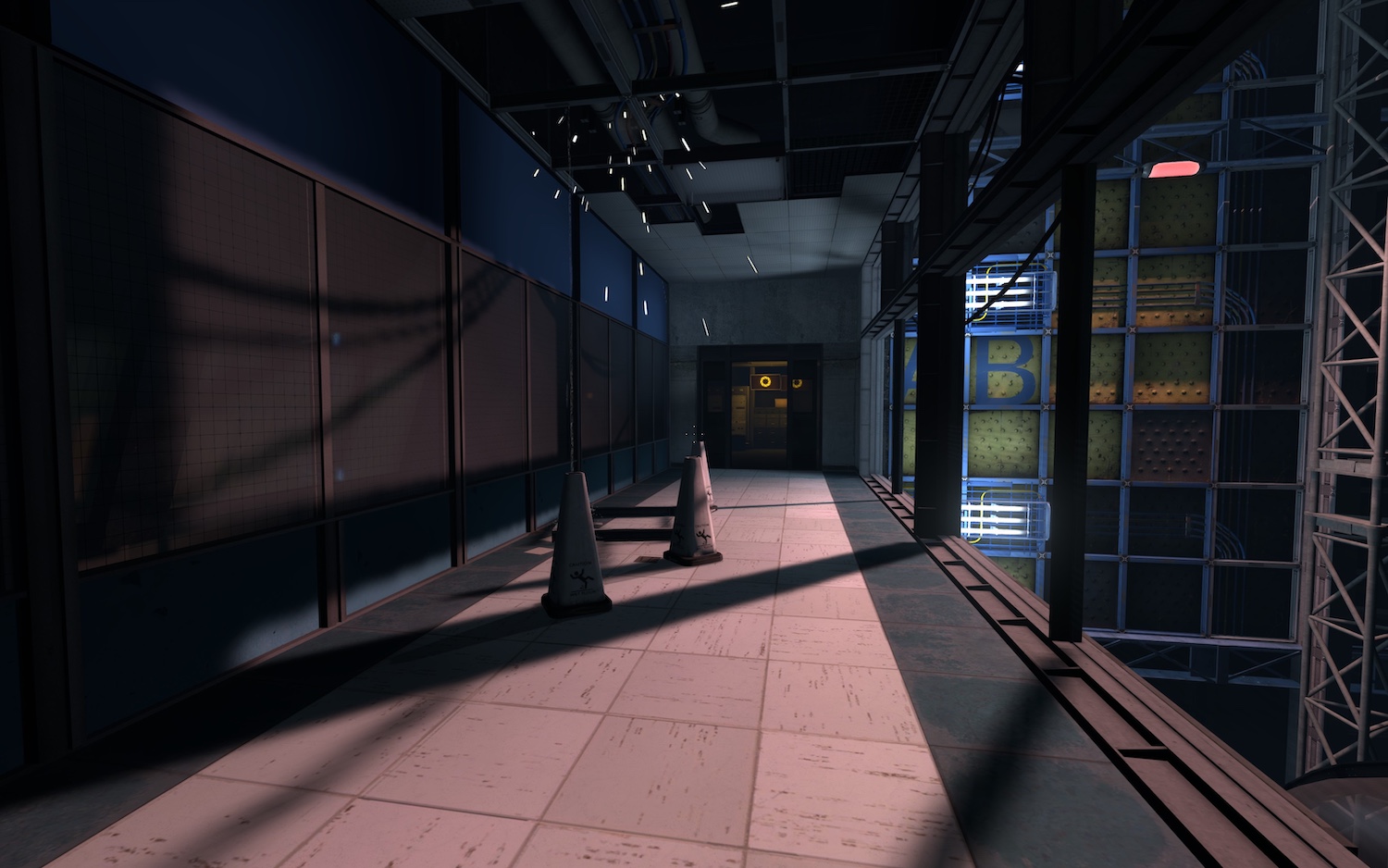
Visually, Revolution is stunning. It introduces higher resolution textures, which are by-and-large suitable replacements for the originals. Large portions of the environment are exposed to the outside world in a way Portal 2 is not, utilising cascaded shadow maps for realistic outdoors illumination. Foliage is now slightly reflective, and volumetric lighting is used in select places to create convincing rays of light. Some assets are replaced with higher-resolution replicas, which are by and large suitable replacements. A number of other subtle improvements are made, aided by an upgrade from DirectX 9 to 11 and OpenGL to Vulkan.
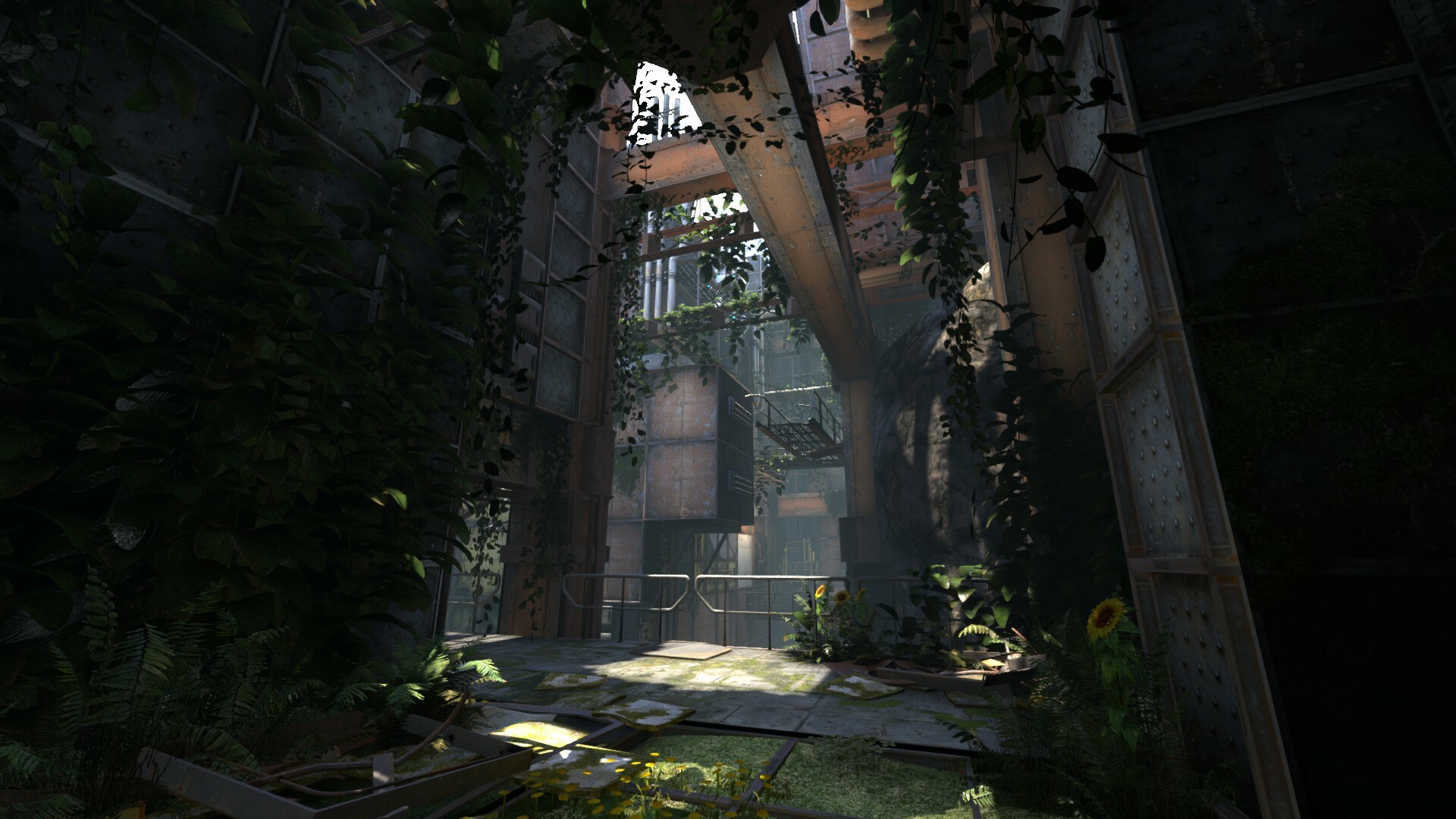
This is not just the result of improved technology, but also impeccable map design, with stunning vistas, overgrown ruins teeming with a wide variety of fauna, and the technological labyrinths one expects from Aperture Science. Unlike Mel, it does introduce a few new visual themes: an "under construction" transitory style between Old and New Apertures, and proper test chambers in behind-the-scenes areas.5 While these help keep things fresh and add to the feeling that you've doing something new and cool and interesting within Aperture (in a way Mel's charming-but-rather-unsurprising environments sometimes don't) they've not a total shift like Old Aperture in Portal 2. One of the high points is the Spire, whose sterile nature thematically fits as a contrast to the dilapidated landscape around it. Throughout the game, the outdoors chambers progress from daylight, then sunset, and finally the nighttime, which is executed nicely to create an effect of progression.
Unlike Mel, which boasts a wide array of set pieces, including the spiderlike AEGIS, an underground train introduction, and a panoply of explosions, Revolution is more restrained. Cores often lurk behind panels, with their animatics being minimal when they appear, and the amount of custom models is on the lower side. It basically attempts to have the minimum amount of set pieces one can while still feeling like a full-fledged campaign and not a Reloaded-esque affair. This is an admitted decision to save developer time: Revolution was pushed out on a very strict deadline. To their credit, it is an often successful one, at times being unnoticeable, and during the latter portions of the game it fits nicely with the game's themes. Still, it can occasionally rob the world of a certain joie de vivre and soul.
Portal Revolution's story is probably its weakest link, but can be still compelling and interesting. The dialogue is decent enough and largely carries the mod forwards, with some funny moments, even if it doesn't come close to reaching Portal 2 (not that such a thing would realistically be achievable for a small team), and the premise is a bit generic at first and takes a while to come into its own. This ends up being a disappointment compared to its more unique forbears: in Mel, the protagonist begins in the 50s, and is shunted into the future after a scientific fuckup, but in Revolution, they just wake up and do some tests.
In general, portions of the early game can come off as a bit uninspired at times; just like in Portal 2, there are surprise test chambers where you are flung into the behind-the-scenes areas, and jokes are often retreads of Valve's material. Some find the introductory core character, Stirling, to be grating at first, and I can see why, but there is more to the writing than him; as the game progresses, some interesting concepts and unique thematic elements are explored. Ultimately though, the story is still very much a flawed product; to explain its pros and cons in more depth, I'll have to do some comparison with Portal 2 and Mel, and unfortunately delve into lots of spoilers.
Lengthy expounding about Portal: Revolution's plot, including many spoilers
Around 25 percent of the way through the game, the player just randomly falls down a lift. In the developer commentary, this is explained as a way to communicate the difficulty of the journey and break things up, but in game it feels insufficiently justified. The same feeling permeates the game's first half. At its worst, in Revolution-land, stuff just kinda happens because the writer dictates it.
Although the player has the stated goal of reaching the Spire (with a very beautiful visual setpiece), the actual journey there sometimes feels a bit like a tour through (admittedly very pretty) environments and (admittedly very fun) puzzles with the ultimate objective being a very thin pretext. In Portal 1, the clean manicured chambers slowly become more disturbing as you realise what is going on. In Portal 2, the chambers start off dilapidated with Aperture abandoned for eons, but then GLaDOS fixes them and Wheatley smashes them together. To a lesser degree, Mel suffers from the same flaw, but even there you try to go through the shrubbery to avoid AEGIS, and the goo is rising beneath you all the time, adding pressure and momentum to the narrative. In Revolution, it can sometimes feel like the locations are arbitrary and not influenced by player action or the wider plot.
This lack of depth also extends to the characterisation. Stirling is charming at times, but he doesn't have the same magnetism or connection to the world around him as his cohorts. His dialogue sells the fact that he sees Aperture as a workspace quite well, but we often don't get a sense of him being a cleaning robot; there's space to incorporate this idea into the dialogue more without being excessive. Fortunately, in the second half of the game, things start to show promise of becoming more meaningful. The player reaches the Spire, which has a unique environment and adds interesting elements to Aperture's lore. Then they unfold into an abandoned expanse, which feels more desolate than any in Portal 2. Exploring these ruins leads to Conly, who has a great personality and superb voice acting by Sarah Jacklin.6 As the player ferries Conly back up to the Enrichment Centre's upper reaches, one gets enveloped in dread and loss, as there is a neat tonal shift to darker and more depressing environs.7
But this quality progression is abruptly broken by Stirling's heel turn, which is not really sufficiently explained or justified. It may make sense in line with his ultimate motivations, but the game doesn't really sell that fact, and it really forgets to make him into much of a compelling villain at all. Going back to the point I made outside this big spoiler disclosure thingamajig, it also feels like he isn't sufficiently distinct from Wheatley in Portal 2. The funniest villain line he has, where the player character is standing on a precipice and he suggests various ways of getting rid of her... well, Wheatley does the same thing in Portal 2, though the creativity of the new scenarios keeps things entertaining at least. The least funny line he has, where he makes a kinda problematic jab about brain damage, is also a retread of Portal 2, but that game is at least capable of getting away with it due to vastly superior writing.8 Even his plot arc, where he is your eager helper and guide, then loses you in an dilapidated and revelation-laden underground area, betrays you at the ninth hour when you re-emerge, and finally is very insecure towards both you and his superior... is pretty much the same as Portal 2. Though Heinz claims the last one was unintentional, and I don't think he's lying, a lack of intentionality doesn't make the player not feel like they've done it all before. It is really a testament to other aspects of the mod that these flaws don't totally ruin the whole enchilada.
The most controversial part of Revolution is the ending. Personally, I'm in the boat that doesn't hate the concept. The actual execution, however, leaves something to be desired. Firstly, in part due to the aforementioned deadlines that Heinz and his team set for themselves, it is very sudden; one is punted out of the final test chamber into the boss fight with barely any buildup. By contrast, Portal 2 has you trying to run away from Wheatley while he cack-handedly attempts to kill you to often amusing effect, and in Mel you run around under AEGIS's nose disabling all its security measures.
The other issue is how the ending is contextualised as part of the narrative arc as a whole. Whilst I'm not a stickler for everyone-hugs-each-other-and-the-universe-is-saved affairs, the way this particular ending is implemented means that it doesn't feel like a rewarding conclusion. To pull off an ambivalent-to-bad ending without it feeling like a slap in the face, the story needs to lead up to in a natural way to prevent it feeling jarring; while some of the more depressing vibes during Conly's ascent do pull things in the right emotional direction, they are ultimately insufficient. While I appreciate Stefan's goal of trying something tonally different, I can't really say he succeeds at it.
Conversely, Revolution's puzzles are probably the strongest part of the game. Extant mechanics, such as hard light bridges, cubes, and tractor beams, used in ingenious ways. Unlike Mel, the puzzles also form a coherent difficulty curve, where introductory chambers introduce or re-acquaint players with a mechanic, and then later expand upon things and combine them for more difficult results. If anything, they are too easy, but apart from a few outliers, solving them rarely feels unsatisfying.
The most interesting puzzles in the mod involve the new mechanics, which are creative and entertaining. After playing Portal 2 I struggled to see what additions Valve could make in a future entry, but these could be used to great effect. There are tubes that suck objects from one portion of a test chamber to another, power switches that can enable and disable both hindrances and helpful elements, and paired cubes that act as laser portals, with one end of a laser entering one cube and issuing from the other. They bring diverse possibilities, and appropriately the chambers use them in a variety of ways. But they are ultimately are somewhat under-utilised: for instance, and I am far from the only person to make this critique, the cubes only make a short appearance in the last ten or so chambers.9
Compared to Mel, Reloaded, and Portal 2, Revolution's music is sparser, sharing some similarity with the sounds of the first Portal game. Quite often, diegetic sound effects take the centre stage instead of the instruments, and tracks often feel like they've just composed of one synth and not much else. It's a nice touch, and there are some neat moments where a swell of music seamlessly phases in at just the right time. Unlike Mel and like Portal 2, many of these tracks within test chambers are dynamic as well: when you kill a turret or make a fling, the music reacts to you progressing in the test. These two changes mean that compared to Mel, the aural environment of the mod feels more reactive and less constant. Mel's music is nice to listen to outside of the game, but can feel a bit repetitive in test chambers; I have no such qualms with Revolution.
However, sometimes this music is too sparse. The tracks' simplicity comes off as fine-tuned minimalism in many places, but a few are left wanting for more aural complexity. Especially outside of tests, the game can stretch into overlong periods of silence, with some areas lacking any music at all (again, this is a consequence of the mod's expeditious release). While not every moment needs music, a few areas such as entering the Spire or just after the Spire fails and you are teleported to Old Aperture felt they deserved more musical acknowledgement than they got.
I feel like equating Revolution to Portal 3 is doing it a disservice. Unlike some people,10 I like many things about the mod, but I acknowledge that it has flaws as well. Ultimately, comparing it to a new title puts it on a pedestal, creating a vision of a Valve-like holistic product which perfectly solves fans' Portal fix, creating unrealistic expectations that can't be met, and sandpapering over the actual development process.
3.9 out of 5 Novov Affirmation Points- 1
Even though Valve's Hammer editor (with a lineage stretching all the way back to Quake) is still based around the "old way" of doing things in many respects, the additional graphical detail still makes development harder.
- 2
"Major" being defined as receiving some news coverage by gaming sites and being listed on Steam as a standalone title, at the time of Revolution's release.
- 3
Probably a bit more annoying for a Portal 2 lore aficionado like me, who considers the lack of an adequate transition between Old and New Aperture to be an important omission.
- 4
To put it another way, if this were Portal 3 this would be percieved as an insipid retread, but in this case it is a testament to the team's skill.
- 5
Although these are visually attractive, the actual convincingness from a lore perspective is questionable at times. I'll excuse it though.
- 6
Why she hasn't got heaps of roles is beyond me. Though perhaps I'm just biased towards my Antipodean cohorts.
- 7
Though the interspersion of test chambers and behind-the-scenes sections seems rather contrived at times.
- 8
I've had a concussion once, I can give GLaDOS a pass. - 9
To be fair, a similar critique could be made about the gels in Portal 2, though to a lesser extent.
- 10
Also... a bit of a rant, but Revolution does take into account the Borealis, sorry. Like if you are going to complain about the game not taking into Portal lore, at least get your details right... still a very interesting video overall, even if I absolutely disagree about Revolution or about Mel's excessive cube-swapping being a good thing.